
Why sustainable operations are indispensable today
Modern raw material extraction is closely linked to ecological responsibility and social stability. A mining project is not just a technical task, but an intervention in natural and social structures. For Ares Maximus, sustainable operation therefore means consistently minimising environmental impact, guaranteeing safety and creating long-term prospects for the region. For us, sustainability is not an add-on, but a consistent benchmark for quality.
The principle: operations and the environment belong together
A mining area is a complex system. Soil, water, vegetation, air quality and biodiversity are in a constant state of equilibrium that reacts sensitively to changes. For this reason, all operating phases are accompanied by comprehensive environmental programmes. These include water analyses, noise measurements, air quality tests, biotope observations and sediment controls.
Reference values are documented prior to dismantling, which are later used to precisely monitor the effects and take countermeasures at an early stage. Sustainability is not achieved through individual measures, but through a process that remains transparent and traceable.
Structured environmental management for every operational step
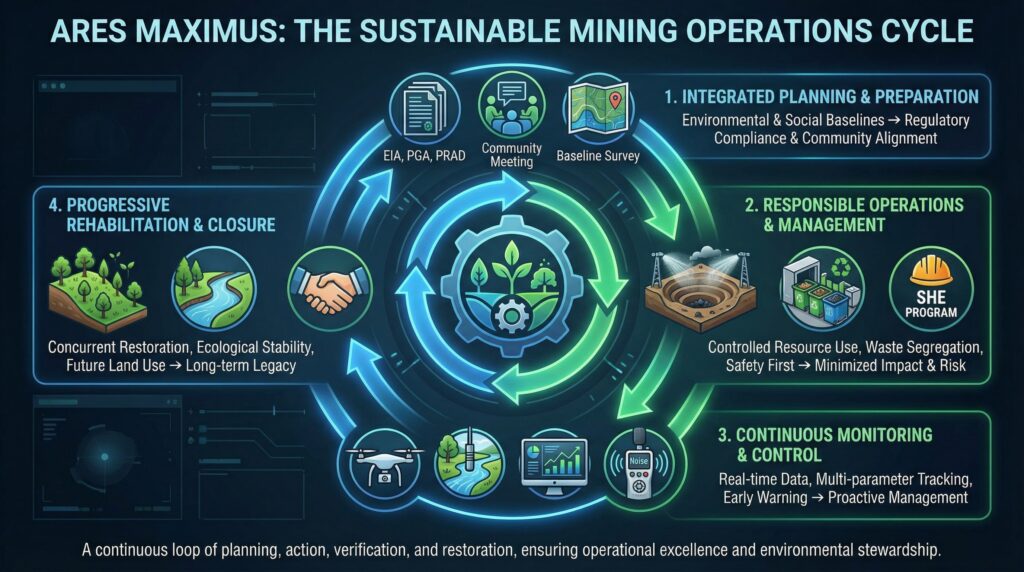
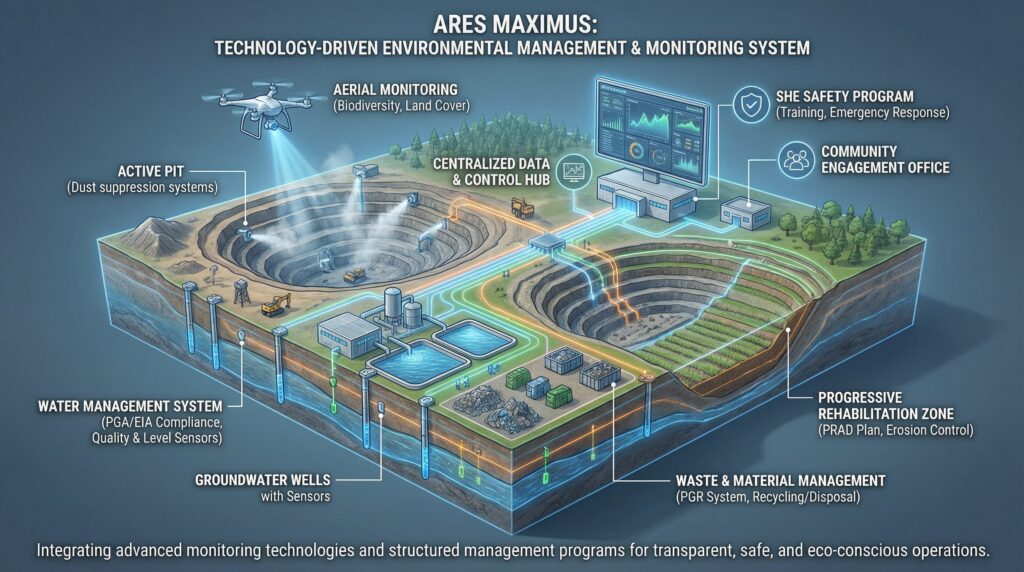
Ares Maximus' environmental management system consists of several interlinked core modules. These include the environmental management programme (PGA), the waste management system (PGR), the environmental impact analysis (EIA) and the restoration plan (PRAD). Each module fulfils its own function, but together they form a comprehensive protection and control system.
In day-to-day operations, this means
- Clear specifications for water and energy consumption
- Controlled handling of materials and waste
- Minimisation of dust and noise emissions
- Regular measurements of critical environmental parameters
- Safety training and medical screening for employees
- Documented processes and audit mechanisms
This combination makes operation calculable, safe and controllable.
Monitoring: the basis for long-term stability
Continuous monitoring is an essential component of sustainably managed mining projects. Ares Maximus relies on modern measurement technologies, GPS-based operational analyses, water quality laboratories, drone surveys and independent testing procedures.
Regular measuring points allow changes to be recognised at an early stage. This applies to
- Water levels and groundwater movements
- Quality of surface and groundwater
- Vegetation development
- occurring sediments
- Changes in the microclimate
- Noise and vibrations
- geotechnical stability
All measurement data is fed into an internal control system that recognises deviations immediately. This allows risks to be managed proactively instead of reactively - a decisive advantage for safety and the environment.
The role of recultivation: restoration instead of legacy
Sustainable mining operations do not end with extraction, but with the restoration of the land. The way in which individual sub-areas should look later is already determined during operation: Vegetation, soil structure, water flows, agricultural potential and ecological stability.
The PRAD regeneration plan ensures that affected areas are gradually recultivated. This includes
- Filling and stabilisation of individual extraction zones
- Restoration of natural drainage channels
- Erosion control measures
- Planting of site-typical vegetation
- Maintenance and inspection phases after completion of the work
A recultivated area should not only be stable, but also ecologically and socially usable.
Safety as an integral part of sustainable operations
The environment and operational safety are closely linked. Ares Maximus' SHE safety programme defines how hazards are identified, minimised and documented. This includes training, equipment checks, emergency response tactics and regular safety drills.
A well-structured safety culture not only protects employees, but also stabilises the environment: fewer accidents, fewer unexpected interventions, fewer material losses and clearly defined processes.
Cooperation with municipalities and authorities
Sustainable operations only work if the region is involved. Ares Maximus works directly with local communities, government agencies and independent expert advisors. This includes joint information events, feedback rounds, regional development programmes and transparent communication about operational processes.
This openness creates trust - and facilitates the development of solutions that combine social, ecological and economic interests.
Conclusion
Sustainable mining is an ongoing process that goes far beyond the mere extraction of raw materials. It requires technical knowledge, clear rules, consistent monitoring and partnership-based cooperation. Ares Maximus integrates these elements into every step of the operation, creating projects that combine responsibility, efficiency and future-orientation. For us, an operation is only successful if it is managed safely, protects the environment and creates long-term prospects for the region.

